
Symposium Cumanum 2027
Censorship and Virgil
June 21–25, 2027
Villa Vergiliana, Bacoli–Cuma
Organizers: Carlos Mariscal de Gante (UNAM) and Erika Valdivieso (Yale)
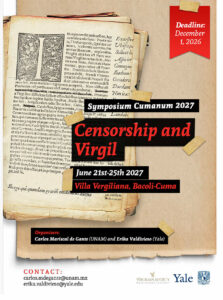 Virgil’s canonical status has entangled him in the moral, political, and critical judgments of readers. We can see this phenomenon from the beginning of the biographical tradition: his disputed self-censorship of the end of the Georgics; his alleged request to burn the Aeneid; the emperor Caligula’s threat to burn Virgil’s poems and imagines (nullius ingenii minimaeque doctrinae, Calig. 34). We therefore propose a symposium that focuses on Virgil and censorship, tracing the history of how readers shape his poetry to reflect their own expectations.
Attention to the role of censorship in the reception of Virgil’s poetry brings to light implicit cultural values in various contexts of reception. The Roman poet can act as an index for a history of discomfort caused by differences in psychology, ideology, gender, philosophy, or religion. To study these phenomena, we shall handle different concepts of censorship, from the material censorship carried out by centralized institutions to forms of ‘soft’ censorship, the act of individual readers and authors. We invite papers that reflect on Virgil’s multifaceted link with censorship, from the composition of his work and its textual transmission to the cultural impact of his poetry and its modern receptions. Topics may include, but are not limited to:
- Accounts of Virgil’s self-censorship (for example, the Laudes Galli)
- Imitations that seek to ‘correct’ their Virgilian models
- Centos as ways to recompose and/or eliminate features of Virgil’s poems
- Commentary and biographical traditions that record instances of censorship
- Commentary and biographical traditions that attempt to censor Virgil
- Evidence of material censorship in the manuscript and printed history of Virgil’s works
- Literary canons as a form of ‘soft’ censorship
- Censorship and the creation of a closed or univocal Virgil
- Translations and their paratexts as devices to alter Virgilian verses
- Receptions of Virgil as means to avoid censorship or, on the contrary, cater to it.
Confirmed Speakers
- Sergio Casali (Università degli Studi di Roma “Tor Vergata”)
- Paola Gagliardi (Università della Basilicata)
- Elena Giusti (University of Cambridge)
- Irene Peirano Garrison (Harvard University)
- Giampiero Scafoglio (Université Côte d’Azur)
- Viola Starnone (Scuola Normale Superiore di Pisa)
- Fabio Stok (Università degli Studi di Roma Tor Vergata)
- Richard Thomas (Harvard University)
- Zara Torlone (Miami University)
Please send abstracts of roughly 300 words to carlos.mdegante@unam.mx and erika.valdivieso@yale.edu by December 1st, 2026. Papers will be 20 minutes long, with time for discussion after each. We hope to gather an inclusive group of speakers from multiple backgrounds and academic ranks, and especially encourage submissions from scholars belonging to communities underrepresented in the field.