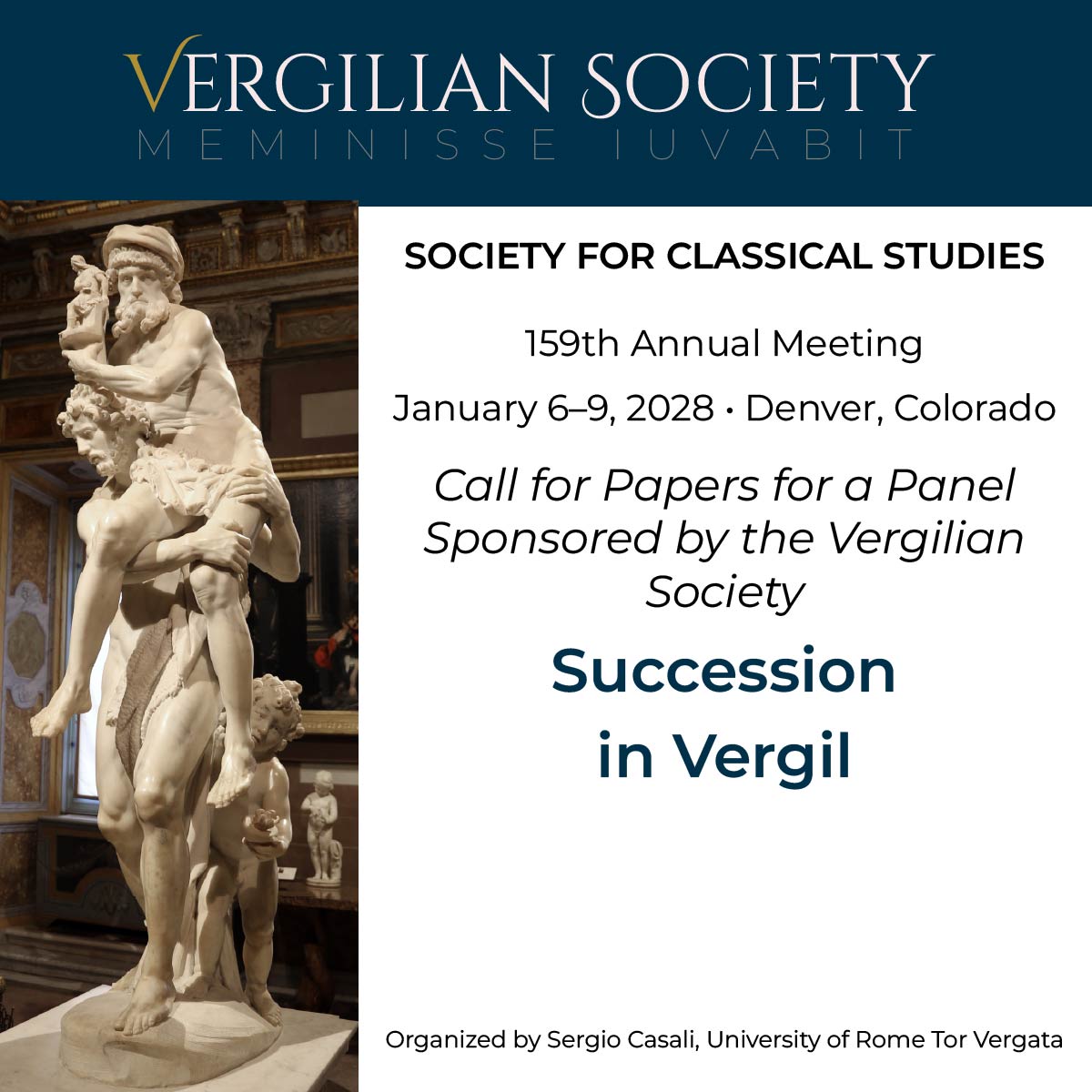
Call for Papers: SCS 2028
SOCIETY FOR CLASSICAL STUDIES
159th Annual Meeting
January 6–9, 2028 • Denver, Colorado
Call for Papers for a Panel Sponsored by the Vergilian Society
Succession in Vergil
Organized by Sergio Casali, University of Rome Tor Vergata
The Vergilian Society invites papers for its panel at the 2028 Annual Meeting of the Society for Classical Studies that explore succession in Vergil’s poetry and its reception. We welcome contributions on the Eclogues, Georgics, and Aeneid, as well as on their reception in any period, language, or cultural setting.
Succession connects some of Vergil’s most hopeful visions of the future with his most searching representations of loss. Gallus receives the pipes once given to Hesiod (Ecl. 6.69–73); the bees’ community endures as one generation replaces another (G. 4.206–209); Anchises’ vision of Rome’s future culminates in the lament for Marcellus (Aen. 6.860–886). These scenes offer different ways of imagining what can survive its present possessor, and what cannot. The handing on of a song, the persistence of a community, and the expectations invested in an heir raise questions about the relationship between continuity and change.
Succession also depends on claims that may be recognized, negotiated, or resisted. What entitles someone to take a predecessor’s place: descent, adoption, marriage, merit, divine sanction, or conquest? How do inherited obligations shape a successor’s freedom to act? The passage from Troy to Italy and Rome makes the survival of names, customs, and memories inseparable from the transformation of peoples and political authority. Vergil’s own engagements with Greek and Roman predecessors invite related questions about how poets establish a lineage, accommodate competing inheritances, and make room for new kinds of poetry.
These questions extend into Vergil’s reception. Later authors, translators, and artists may claim his authority, challenge it, or redirect it towards communities and experiences given little space in his works. Continuations and rewritings can reopen futures that his narratives leave suspended or foreclose. At the same time, Vergilian accounts of descent and the transfer of power can authorize, or help to question, later dynastic, imperial, and national genealogies. We therefore invite attention both to those who become Vergil’s successors and to the changing meanings of succession within the reception of his poetry.
Possible topics include, but are not limited to:
- Kinship and inheritance: biological and adoptive descent, marriage, and the agency of mothers, daughters, and sons in establishing or contesting succession.
- The succession to Aeneas: Ascanius/Iulus and Silvius Postumus, competing genealogical traditions, and the negotiation of Trojan and Latin descent in accounts of Rome’s origins.
- Political succession: transfers of sovereignty, competing claims to legitimacy, the relationship between inheritance and conquest, and Augustan dynastic expectations.
- Interrupted or excluded futures: premature death, childlessness, disinheritance, failed successors, and the emotional or ethical costs of continuity.
- Land, labor, and natural renewal: dispossession and changing ownership, the transmission of agricultural knowledge, and the relationship between generational replacement and recurrent natural cycles.
- Poetic succession: Vergil’s Greek and Roman predecessors, the transmission of pastoral song, literary rivalry, and transformations of inherited genres across his career.
- Narrative and historical time: genealogies, prophecy, repetition, and endings as means of constructing or unsettling continuity between past and future.
- Successors to Vergil: translation, adaptation, and continuation as ways of claiming or contesting a literary inheritance, including the revision of established genealogies of literary authority.
- The transmission and uses of Vergilian authority: commentary, education, and canon formation; later appropriations of his models of succession, including their political uses and critiques.
We particularly welcome papers that bring these areas into conversation while developing a focused argument. The panel aims to explore what makes succession possible or persuasive, and how Vergilian poetry and its readers imagine the responsibilities and possibilities of being an heir.
Please send an abstract for a 15–20-minute paper to Sergio Casali (casali@uniroma2.it) by February 15, 2027, using the subject line “abstract_SCS2028”. Abstracts should be no more than 500 words, excluding bibliography, and should follow the SCS Abstract Submission Guidelines. They should state the paper’s argument, situate it within relevant scholarship, and indicate the evidence to be discussed.
Submission information
Abstracts will be evaluated anonymously. Please omit your name and other identifying information from the abstract, and provide your name, affiliation, and paper title in the accompanying email. Decisions will be communicated by March 1, 2027, in time for authors whose abstracts are not selected to participate in the individual abstract submission process for the 2028 SCS meeting.